Epoxy Flooring in Iowa City, Built on a Tested Slab

We grind every slab, test it for moisture in writing, and name the product, coats and thickness in the quote so you can check the floor against it.

Iowa City Epoxy Flooring has spent 20+ years installing epoxy flooring in Iowa City, IA, coating garage slabs, basement floors, shops, plants and commercial kitchens with systems built for an eastern Iowa winter. Our work covers epoxy garage floors, polished concrete, polyaspartic coatings, metallic and flake floors, concrete grinding and floor repair, and the static-control and food-service floors that commercial buildings need.

Every job starts with the concrete itself. We open the surface with a diamond grinder or shot blaster, test the slab for moisture before the price is final, and write the product line, the number of coats and the finished thickness into the proposal so the floor you get can be checked against the floor you were quoted.

That approach matters in a city where old patched slabs and young ones sit a few blocks apart. Below you will find how we handle garages, basements, decorative finishes and commercial floors, and the questions homeowners and building managers ask us most.

Get Your Free Quote

Fast response • No obligation

So we can reach you about your request.

So we can send you a confirmation after you submit this inquiry form.

  • 20+ Years Coating Concrete
  • Moisture Test in Every Scope
  • Free Written Estimates

What we do

Our Services

Ground, tested and coated concrete floors for Iowa City homes and businesses

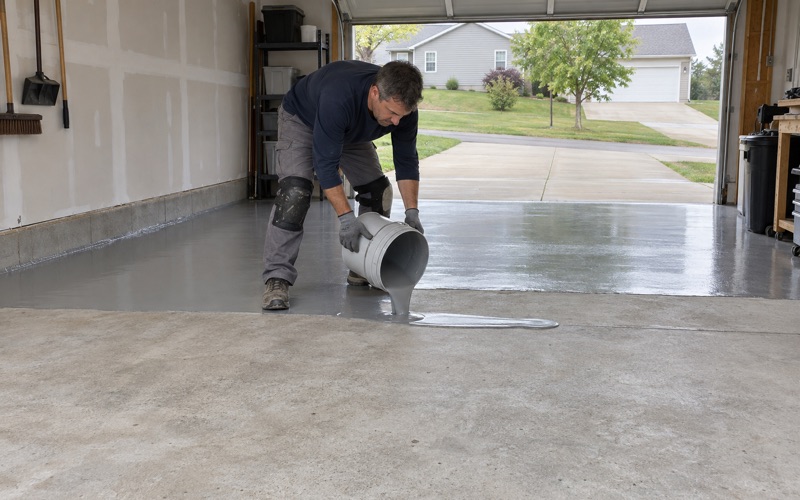
Mixed epoxy poured in a ribbon onto the ground slab of an Iowa City garage, the first coat starting at the back wall.

Epoxy Garage Floor

Ground, moisture-tested and salt-resistant epoxy garage floors for Iowa City homes, with every coat and the finished thickness named in the quote.

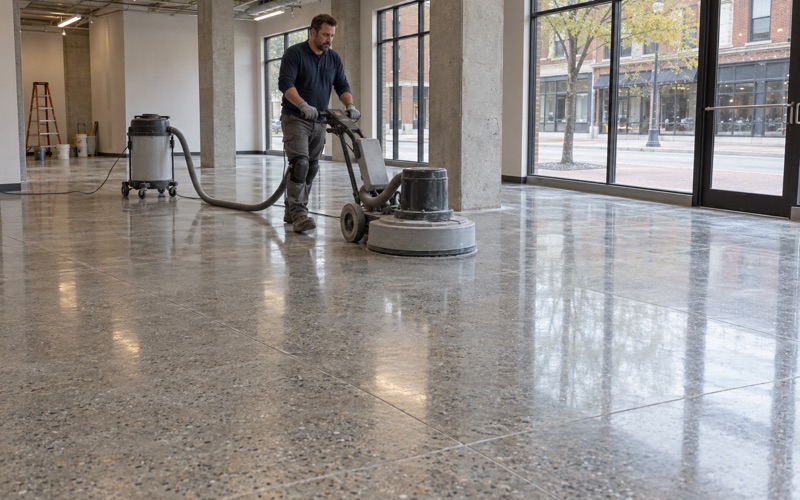
A planetary polisher mid-pass on a new polished concrete floor in the ground-floor storefront of a downtown Iowa City mixed-use building.

Polished Concrete Floors

Ground, densified and polished concrete floors for Iowa City homes and businesses, with a test grind so you choose the finish from your own slab.

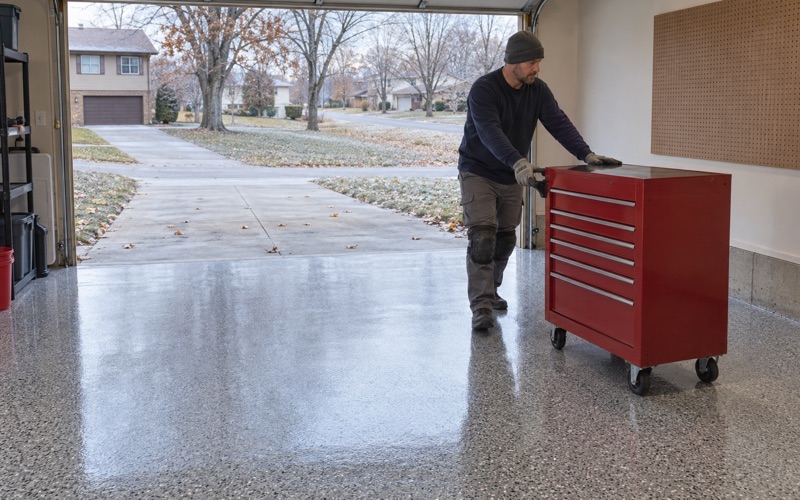
A rolling tool chest wheeled back onto a same-day polyaspartic flake floor in an Iowa City garage on a cold autumn afternoon.

Polyaspartic Floor Coating

Fast-curing, UV-stable polyaspartic floor coatings for Iowa City garages, shops and businesses, applied over a ground and moisture-tested slab.

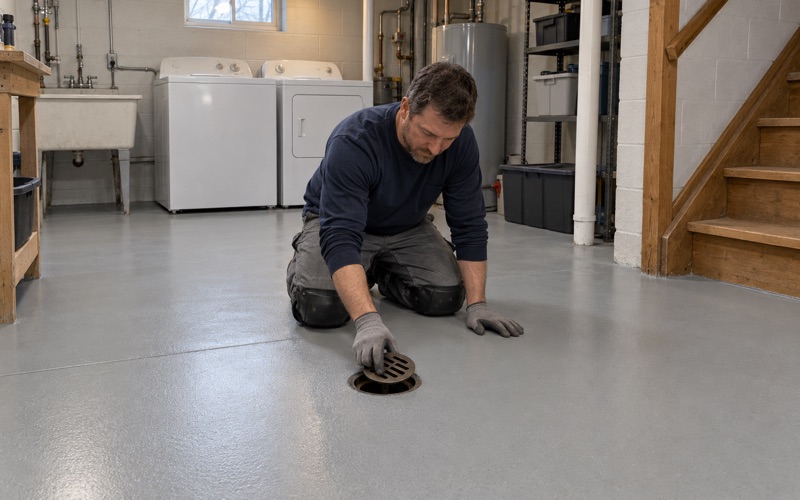
A floor drain grate being set back flush into a new light gray epoxy basement floor in an Iowa City house.

Basement Floor Epoxy

Basement floor epoxy for Iowa City homes and rentals, built on a moisture test, a sump and drain check and a fully ground slab.

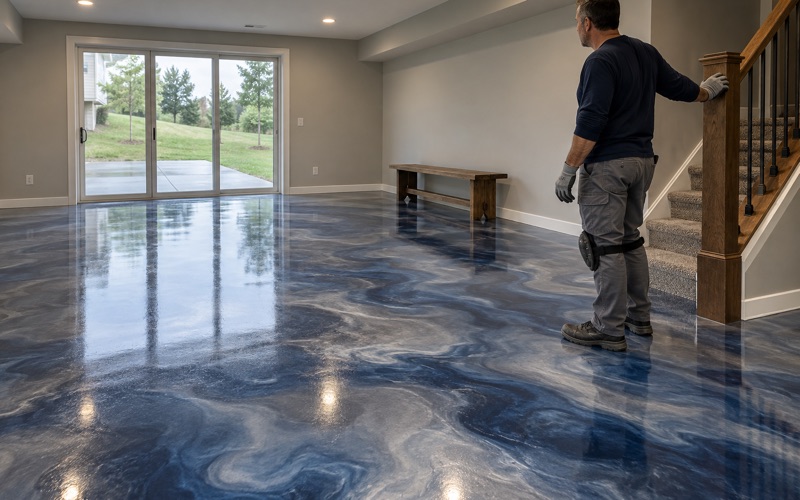
A silver and deep blue metallic epoxy floor in the walkout lower level of an Iowa City house, its swirls catching daylight from the patio door.

Metallic Epoxy Floor

Marbled, reflective metallic epoxy floors for Iowa City homes and businesses, poured over a ground and moisture-tested slab.

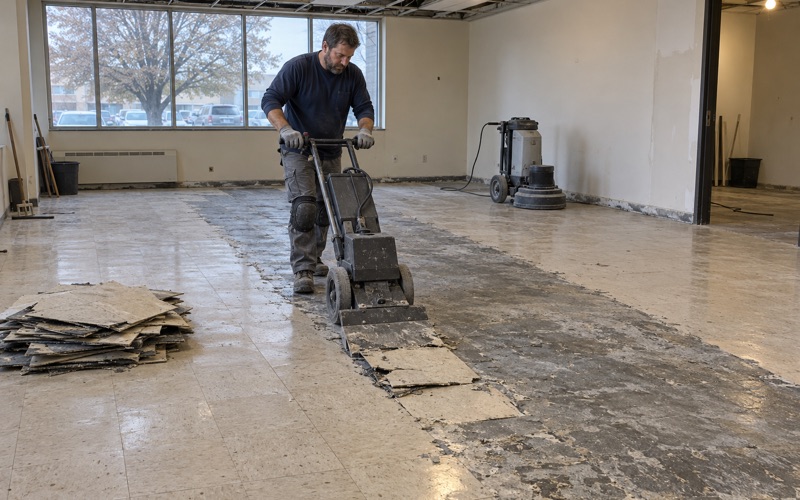
A walk-behind floor scraper peeling old vinyl tile off a slab in an Iowa City office building before the concrete is ground and coated.

Concrete Grinding

Diamond grinding and shot blasting for Iowa City slabs, removing old coatings and adhesive and profiling concrete for a lasting new floor.

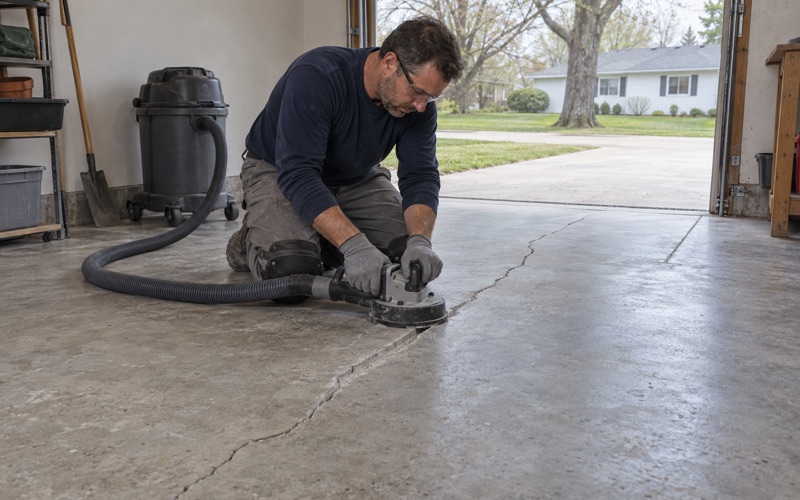
A long crack being chased open with a hand-held crack chaser in an Iowa City garage slab before it is filled and coated.

Concrete Floor Repair

Crack, spall, joint and scaling repair for Iowa City garage, basement and commercial slabs, plus an honest answer when replacement is the better call.

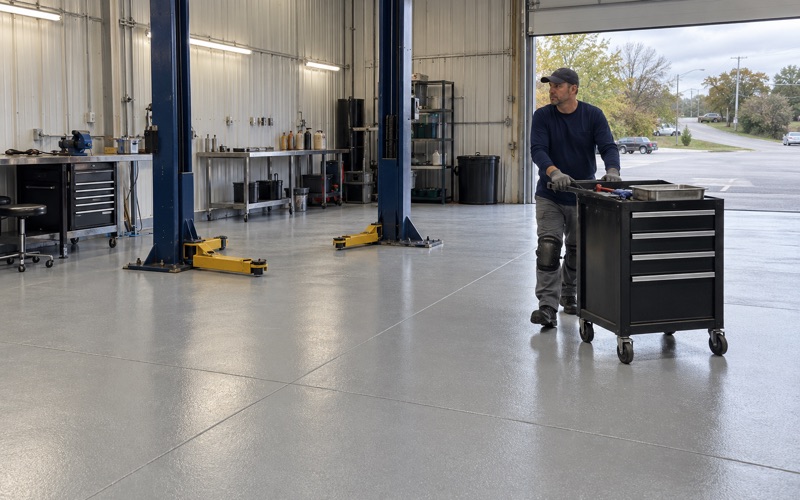
A rolling tool cart pushed across a new gray epoxy floor in the service bay of an Iowa City auto repair shop.

Commercial Epoxy Flooring

Epoxy floors for Iowa City stores, offices, clinics, shops and rental buildings, installed in phases so the business can keep running.

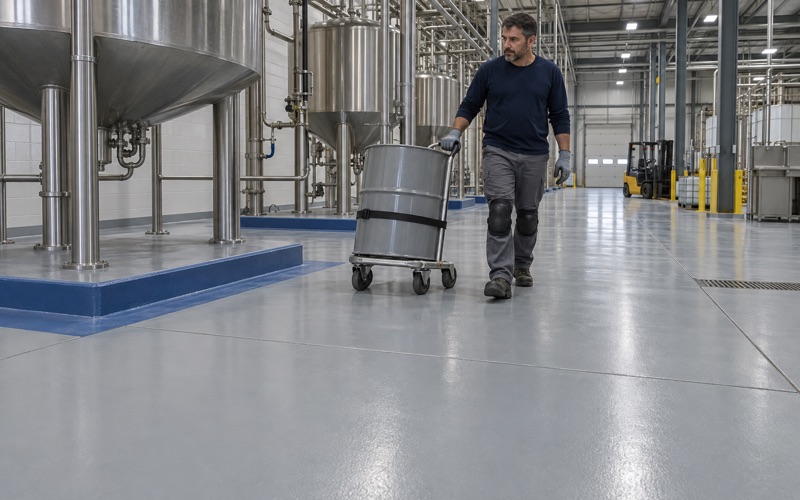
A steel drum wheeled on a drum dolly across a new high-build gray epoxy floor in an Iowa City consumer-goods plant.

Industrial Epoxy Flooring

Heavy-duty epoxy and urethane cement floors for Iowa City plants, warehouses and shops, installed around shifts so production keeps moving.

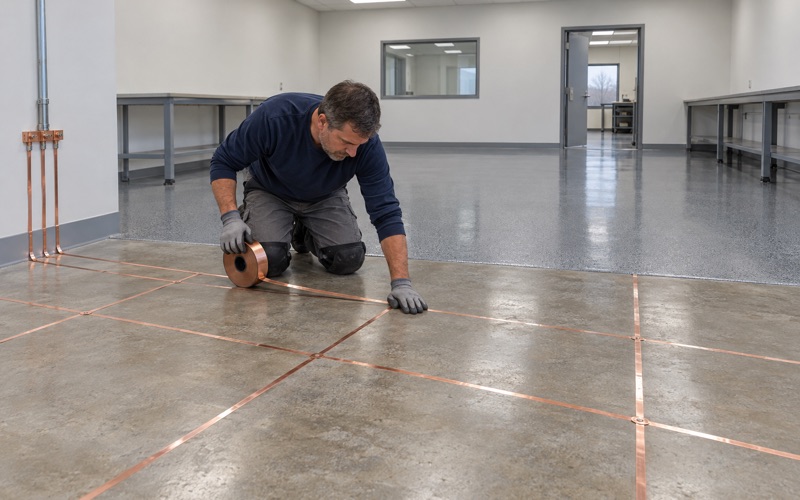
A copper grounding strip being laid on the primed slab of an electronics room near Iowa City before the static-dissipative coat goes down.

ESD Flooring

Static-dissipative and conductive epoxy floors for Iowa City electronics, lab, data and healthcare spaces, built to the resistance range your program sets.

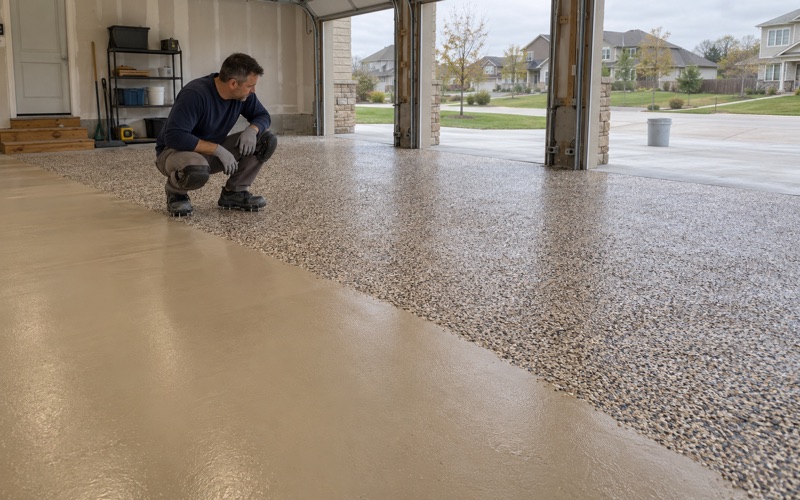
Dense tan, brown and black flake settled on the base coat in an Iowa City garage, the worker checking coverage at the working edge.

Flake Epoxy Floor

Vinyl flake epoxy floors for Iowa City garages, basements and shops, with blend, chip size and broadcast density chosen for your space.

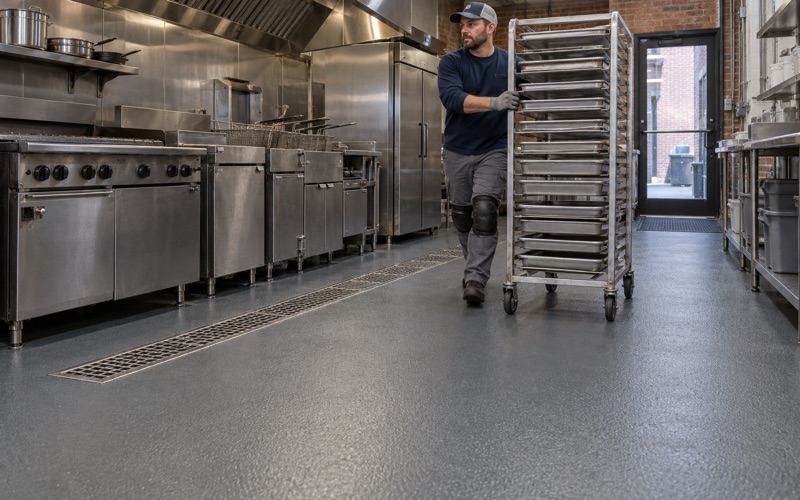
A speed rack rolled across a urethane cement floor with a coved base and trench drain in a busy Iowa City restaurant kitchen.

Commercial Kitchen Flooring

Seamless, coved, slip-resistant kitchen floors for Iowa City restaurants and food businesses, planned around the FDA Food Code Iowa adopts.

Two Decades on Iowa Concrete

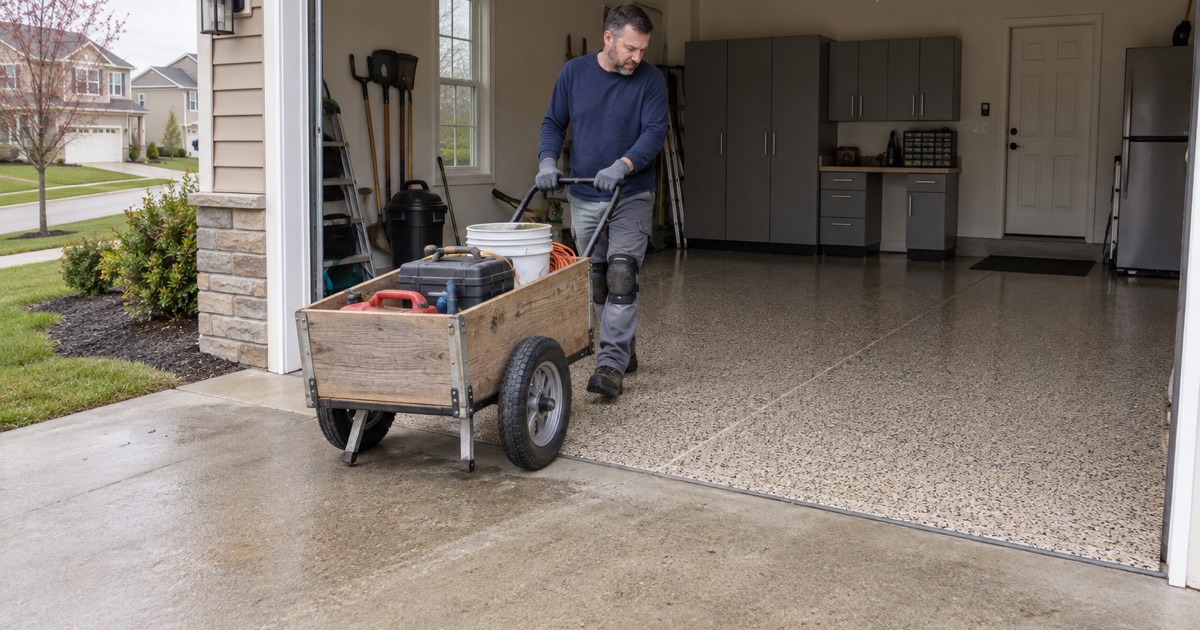
A garden cart wheeled onto a finished tan and charcoal flake floor in the attached garage of a newer two-story house on Iowa City’s east side.

20+ Years of Epoxy Floor Installation

We have been grinding, repairing and coating concrete floors for more than twenty years. That time has taught us that most coating failures start under the coating, in moisture, contamination or a poorly prepared surface, which is why our process spends so much of its effort before the first coat goes down.

Why Choose Iowa City Epoxy Flooring

Ground, Never Acid-Etched

Every slab we coat is opened with a diamond grinder or shot blaster to a measured ICRI surface profile, so the epoxy has real texture to bite into rather than the shallow, uneven etch a muriatic acid wash leaves behind. Peeling in the first winter is usually a preparation failure, and grinding is where we prevent it.

Moisture Tested Before the Price

No proposal of ours is final until the slab has been tested for moisture, whether it sits under a 1920s house near downtown or a garage poured last decade. Vapor pushing up through concrete lifts coatings from below, and finding it after the floor is down costs the owner the whole floor.

Quotes You Can Check

Our written proposals name the product line, the number of coats and the finished thickness. That lets you hold the finished floor up against the paper, so a thin single coat cannot be passed off as a full build the way a vague “epoxy floor” quote allows.

Built for Salt Season

Garage systems here are chosen for the brine and rock salt that ride in on tires from November through March in Johnson County. Calcium chloride and freeze-thaw cycles scale bare concrete, so we specify a sealed, chemical-resistant topcoat that keeps the salt on the surface rather than letting it work into the slab.

Cured by the Slab, Not the Calendar

Never do we schedule a cure by date alone. We read slab temperature and the dew point spread at the surface, and when an unheated Iowa City garage is too cold in January we tell the owner to wait, rather than coating anyway and leaving amine blush and a soft film behind.

The Garage Floor, Start to Finish

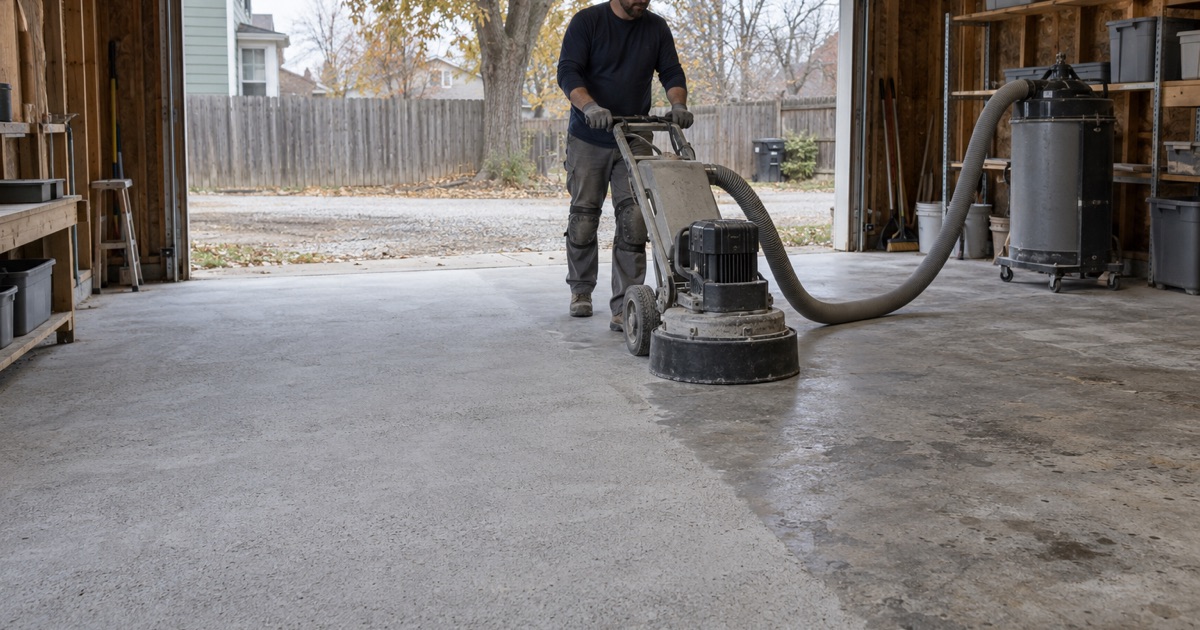
A planetary grinder opening up an old garage slab behind a prewar Iowa City house, half the floor ground and half still sealed.

How an Epoxy Garage Floor Installation Runs

A garage job begins with a slab inspection and moisture test, then grinding, crack and spall repair, the base coat, the broadcast and the topcoat. We walk you through each day before we start, so you know when the garage is off-limits and when the car can come back.

Attached and Detached Garage Coatings

An attached garage shares air with the house, so we capture grinding dust at the machine with a vacuum and plan the coating schedule around the door into the kitchen or mudroom. Detached garages give more freedom on product choice, though the same preparation applies to both.

Garage Slab Moisture Testing

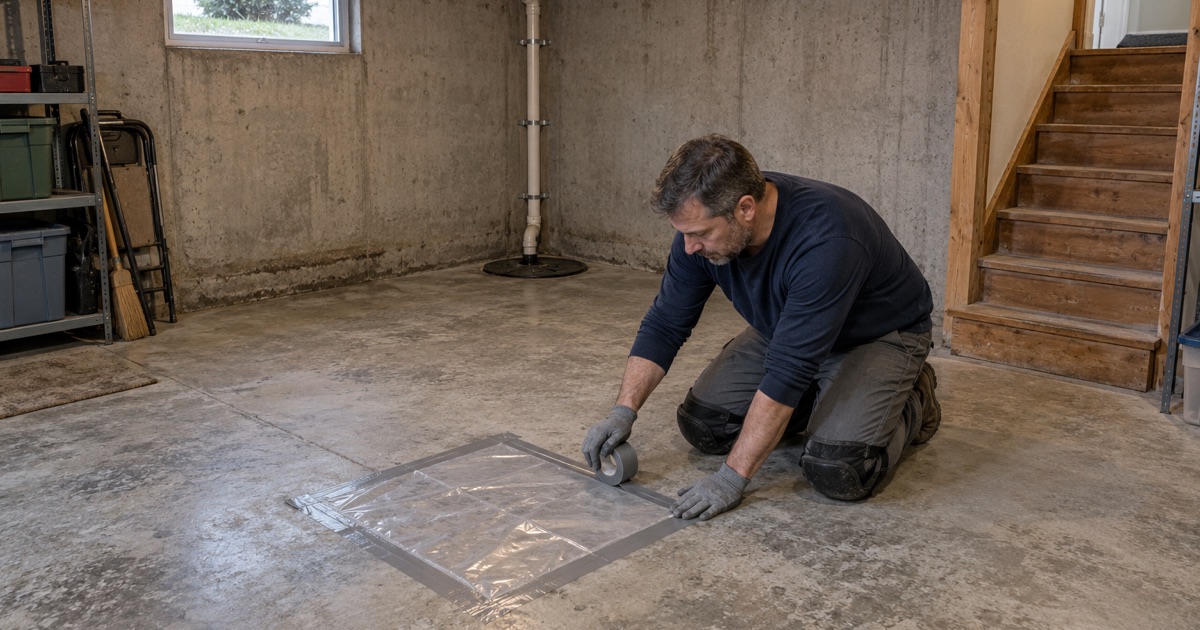
We use the ASTM D4263 plastic sheet test as a quick read and calcium chloride emission testing under ASTM F1869 or in-situ relative humidity probes under ASTM F2170 when a number is needed. The result decides whether the slab takes a standard base coat or a moisture-mitigation primer first.

Newer Homes and Damp Garage Slabs

The 2024 International Residential Code allows garage floors to skip the under-slab vapor retarder that habitable rooms need, under the R506.2.3 exception. A garage poured five years ago can therefore move more moisture than an old one, which is why we test the slab whatever year the house was built.

Cracked, Spalled and Pitted Garage Concrete

We map cracks, spalls and pitting before quoting, then fill and grind them flush so they do not telegraph through the finished coating. When a slab has heaved, broken into loose pieces or settled badly, we say so plainly, because coating a floor that needs replacing only hides the problem for a season.

Road Salt on a Bare Garage Floor

Brine and rock salt carried in on tires soak into uncoated concrete, and repeated freezing and thawing then pops the surface into flakes and scaling. A ground and coated floor keeps meltwater on top, where a squeegee clears it, rather than letting it work into the paste.

Cold-Weather Garage Coating

Most coatings need a minimum slab temperature and a safe gap between the surface and the dew point to cure properly. Iowa City averages about 130 nights a year at or below freezing, so an unheated garage between late fall and spring often needs a heater for the cure window or a later date on the calendar.

Hot Tire Pickup and Garage Coatings

Tires heat up on the road, and a thin or soft coating softens under them, bonds to the rubber and lifts off when the car pulls out. A ground slab, a full-build 100% solids epoxy and a hard polyaspartic or polyurea topcoat resist that hot tire pickup far better than a roll-on paint.

DIY Epoxy Kits Versus a Professional Garage Floor

Big-box kits are mostly water-based epoxy applied thin over an acid-etched slab, with no moisture test and no repair. A professional floor starts with diamond grinding and builds to a measured thickness in several coats, which is the difference between a finish that peels at the tire tracks and one that lasts.

Epoxy Garage Floor Cost Factors

The price of a garage floor moves with square footage, the crack and spall repair needed, any old coating to remove, the moisture result and the system chosen. A flake floor with a polyaspartic topcoat and a metallic floor sit at different points, and we lay out each line item so you can compare.

Basements, Sump Pits and Damp Slabs

A square of plastic sheeting taped down on an Iowa City basement slab to check for moisture before any coating is chosen.

Basement Floor Epoxy and the Moisture Question

Before we coat a basement, we answer one question: how much moisture is coming up through this slab? Below-grade concrete sits against damp soil year-round, so a basement floor coating starts with testing and a look for past water, not with color samples.

Sump Pits, Drain Tile and Floor Drains

We check the sump pit, the drain tile discharge and every floor drain before work starts, because they tell us how water has moved through the basement. The coating is carried to the drain edges and sump lid neatly, never sealed over a drain that the house depends on to stay dry.

Older Basement Floors With Paint and Tile Glue

Many older basements under Iowa City houses and duplexes carry decades of paint, patching compound and black tile adhesive. We grind or shot blast those layers off to sound concrete, since a new coating bonded to a loose old one fails right along with it.

Lower Levels in the Iowa River Floodplain

The Iowa River at Iowa City crested at a record 31.53 feet in June 2008, and low-lying neighborhoods and buildings took water. A coated floor cleans up far better after a flood than bare concrete or carpet, but it does not keep water out, and we do not sell it as flood protection.

Efflorescence on a Basement Slab

White powder on a basement floor is efflorescence: salts carried up by moisture and left behind when the water evaporates. It tells us vapor is moving through the slab, so we test before coating and plan the primer around what the numbers show.

Moisture-Mitigation Primer for Basement Concrete

When a basement slab tests above the limit for a standard epoxy, a moisture-mitigation primer goes down first. It is rated to hold back a measured level of vapor emission, which gives the coating above it a stable surface instead of one pushing blisters from underneath.

Coating After Water Gets In

If a basement has flooded or seeped recently, the slab needs cleaning, drying and retesting before any coating goes down. We will not coat a wet floor to meet a date, because trapped moisture is the most common reason basement coatings blister and peel.

Coated Floors for Laundry Rooms, Workshops and Home Gyms

A coated basement floor handles detergent spills, sawdust and dropped weights better than bare concrete. We adjust the texture and topcoat to the room, with more grip around washers and more impact resistance under a weight rack.

Coating Warranty Exclusions

Most coating warranties exclude failures caused by moisture vapor transmission and hydrostatic pressure from beneath the slab. We explain that before the job is sold, so the test result and the warranty terms are both on the table when you decide.

Floor Coatings, Radon and Waterproofing

A floor coating is not radon mitigation and it is not waterproofing. Every Iowa county sits in EPA radon Zone 1, and radon testing and mitigation in Iowa require a state credential under Iowa Code chapter 136B, so we refer that work to credentialed specialists and keep our scope to the floor.

Color, Flake and Finish

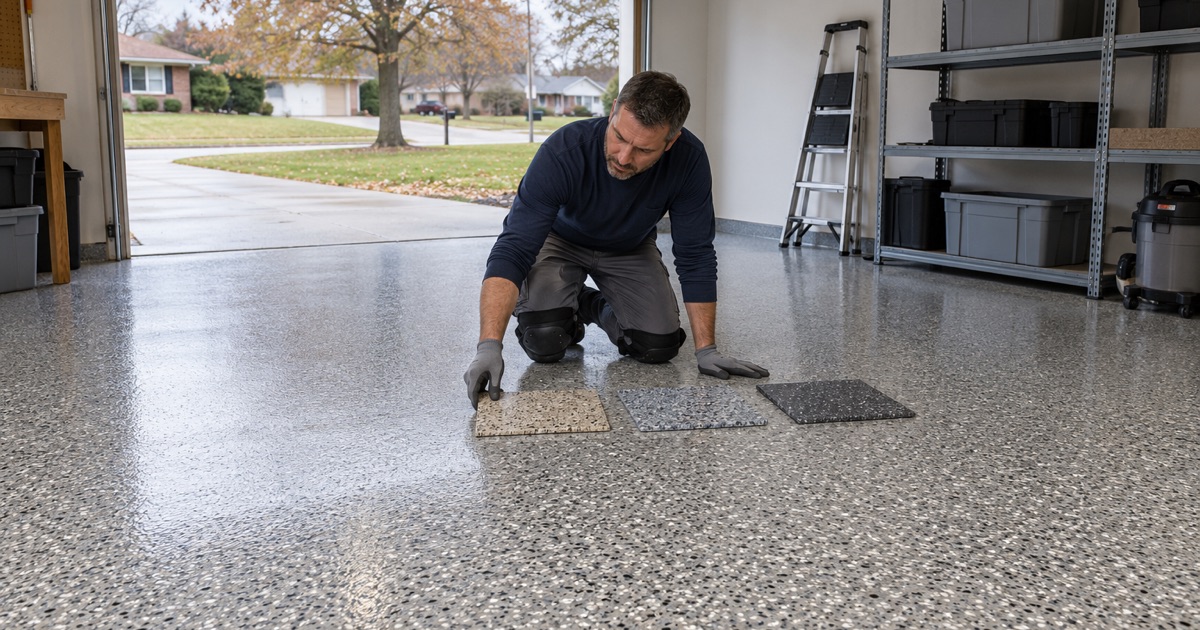
Three flake color samples laid side by side on the finished topcoat of an Iowa City ranch house garage floor.

Vinyl Flake Epoxy Floors

A vinyl flake broadcast hides dust, small imperfections and tire marks while adding texture underfoot. Chip size and blend change the look, from a fine speckle to a bold full-broadcast floor, and we bring physical samples so you can see them on your own slab.

Metallic Epoxy Floor Installation

Metallic epoxy uses pigments that move as the coating levels, leaving a marbled, three-dimensional finish no two floors share. It takes a flat, well-prepared slab and an installer who manipulates the material within its working time, and we set expectations on pattern and variation before we start.

Polished Concrete Floors and Aggregate Exposure

Polished concrete is ground in stages with progressively finer diamonds and hardened with a lithium silicate densifier. A light grind leaves a cream finish, a deeper one exposes fine or larger aggregate, and we test-grind a small area so you choose the look from your own concrete.

Gloss, Satin and Matte Topcoats

High gloss shows the most depth and color but also the most dust and scuffs. Satin and matte finishes hide tire marks and footprints better, and we often recommend them for working garages and shops where the floor sees daily use.

Quartz Broadcast Flooring

A quartz aggregate broadcast adds color and slip resistance in the same step, which is why it shows up in commercial restrooms, ramps and kitchens. The size of the quartz and the number of topcoats decide how aggressive the texture feels underfoot.

Solid Color Floor Coatings

A solid color coating suits a utility room, a storage area or a shop where function matters more than decoration. It costs less than a decorative system and can still carry a grit additive in the topcoat for traction.

UV Exposure and Epoxy Ambering

Standard epoxy can yellow, or amber, when sunlight hits it through an open garage door. Polyaspartic and polyurea topcoats hold their color under ultraviolet exposure, so we put them over epoxy wherever the floor sees daylight.

Saw-Cut Lines, Borders and Logos

Existing control joints and decorative saw cuts can be filled, honored or turned into a design line in the finished floor. Borders, color bands and logos can be laid into commercial floors, and we plan them around the slab’s joints so cracks do not run through the artwork.

Plants, Shops and Commercial Floors

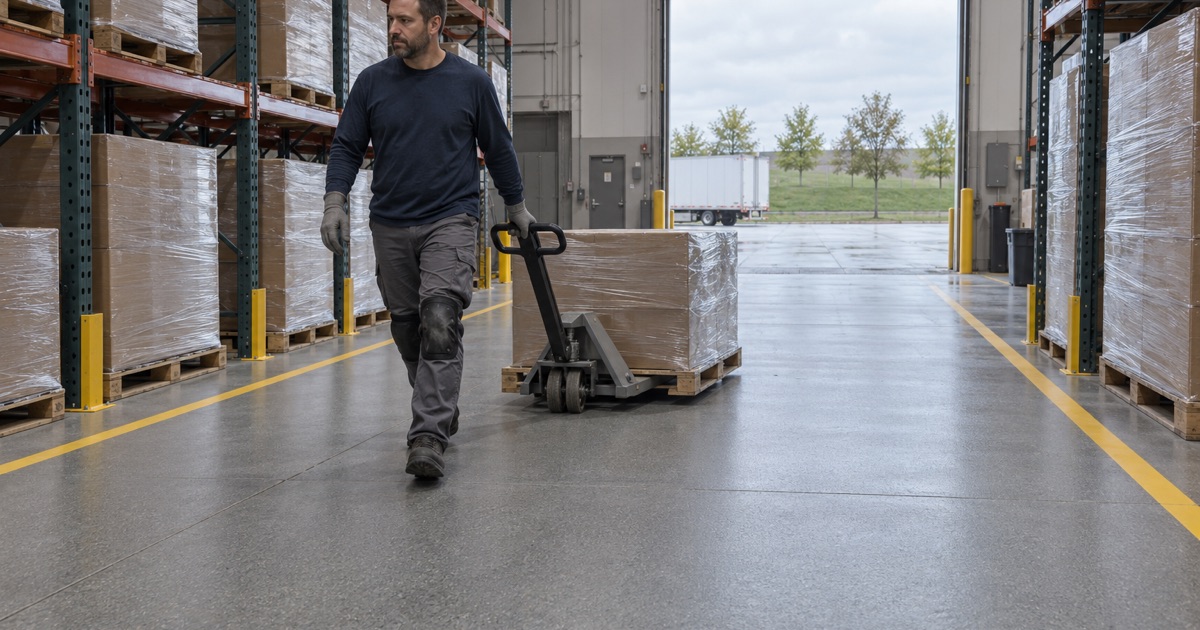
A pallet jack pulled across a new gray quartz-textured epoxy floor in a distribution warehouse at an Iowa City industrial park.

Commercial Epoxy Flooring Projects

A commercial floor carries more square footage, more traffic and a tighter schedule than a home garage. We plan sequencing, cure times and return-to-service dates in writing so a manager can schedule staff, deliveries and inspections around the work.

Industrial Floors for Oil, Coolant and Hydraulic Fluid

Manufacturing floors take oil, coolant, hydraulic fluid and dropped parts every shift. We specify thicker, chemical-resistant systems for those areas, and we grind out oil-soaked concrete before coating so contamination does not lift the floor later.

Food Plant Floors and Daily Washdown

Food processing floors are washed down hard every shift, often with hot water and strong cleaners. Those floors need a sealed, seamless surface with a cove at the wall and a texture that stays slip-resistant when wet.

Urethane Cement for Heat and Harsh Cleaners

Where hot water, steam cleaning and aggressive chemicals would soften an epoxy, urethane cement is the better system. It tolerates thermal shock and constant moisture far better, and we specify it for washdown rooms and areas near ovens or fryers.

Warehouse Floor Coatings Under Forklifts

Forklift and pallet-jack wheels grind at a floor and chip weak coatings at the joints. We specify a high-build system, repair joint edges before coating, and add striping and aisle markings where the operation needs them.

Farm Shop and Equipment Dealer Floors

Farm shops and dealer service bays see heavy equipment, mud, fuel and hydraulic oil. A ground and coated slab makes those spills easier to clean and the space easier to work in through a long Iowa winter.

Commercial Kitchen Flooring and the Food Code

Iowa adopts the 2017 FDA Food Code, and Johnson County Public Health inspects food establishments in Iowa City under contract with the state. The code asks for smooth, durable, cleanable floors and coved floor-wall junctures under 6-201.13, while 6-201.11 permits antislip surfaces where safety requires them, and we plan kitchen floors around both.

Rental Units, Duplexes and Apartment Common Areas

Rental property in Iowa City runs on city rental permits and inspections under the Iowa City Housing Code. A coated basement, laundry room or common-area floor turns over between leases with a cleaning rather than a replacement, and we schedule the work into the gap between tenants.

Office, Clinic and Showroom Floors

Floors in offices, clinics and showrooms need to look finished as well as last. Polished concrete, metallic epoxy or a clean solid color with a satin topcoat gives those spaces a durable surface that still reads as a designed interior.

Federal VOC Limits and Low-Odor Coatings

Iowa has no state VOC content rule for floor coatings; the federal 40 CFR 59 Subpart D limit applies to the manufacturers. Low-odor, 100% solids systems are still worth asking for in occupied buildings, and we offer them as a comfort choice rather than a legal requirement.

Night and Weekend Floor Installation

Plant, warehouse and shop floors are phased around shifts, with overnight and weekend windows when a line cannot stop. We divide large floors into zones so part of the building keeps running while another part cures.

Areas We Serve

Iowa City Epoxy Flooring provides epoxy-flooring throughout the greater Iowa City area, with the same crews and the same standards on every job.

Good to know

Frequently Asked Questions

How much does an epoxy floor cost in Iowa City?

Price follows square footage, the repair the slab needs, the system chosen and the moisture test result, so we quote after seeing and testing the floor rather than over the phone. A clean two-car garage with a flake system sits at the simpler end; a cracked basement slab that needs a moisture-mitigation primer costs more for good reason.

How long does a coated floor take to install?

Most residential garages and basements take one to three working days, depending on repair work and the number of coats. Light foot traffic usually follows within a day, and vehicles wait longer; the exact return-to-service times for the product we install are written into the proposal.

Is your company licensed in Iowa?

Iowa handles contractors through state registration under Iowa Code chapter 91C rather than a city floor license, and Iowa City has no separate general-contractor license that we found. We do not claim a license or certification we do not hold, and we will tell you plainly what applies to your job.

Do I need a permit to coat a concrete floor in Iowa City?

Iowa City enforces the 2024 International Building and Residential Codes with its own amendments, including a list of work exempt from permits. A coating-only job may or may not fall under it, so we confirm with the city rather than assume, and structural or slab replacement work is a different question.

What is the difference between epoxy and polyaspartic?

Epoxy is a thick, strong base that bonds well to ground concrete, while a polyaspartic topcoat cures faster and holds its color under sunlight. Many of our garage systems pair the two: an epoxy base for build and bond, and a polyaspartic top for wear and UV stability.

Can you coat a floor in winter?

Inside a heated building, yes. In an unheated garage we read slab temperature and the dew point spread at the surface, and when the concrete is too cold for the product to cure properly we schedule the job for a warmer stretch instead.

Will the floor be slippery when wet?

Smooth, high-gloss coatings can be slick with water or snowmelt on them. We set the texture by what goes into the floor, such as a flake or quartz broadcast and the grit in the topcoat, and we match that choice to whether the room sees tracked-in slush, wash water or oil.

What warranty comes with the floor?

Coverage depends on the manufacturer and the system, and we hand over the written terms before you sign. Moisture vapor transmission and hydrostatic pressure from below the slab are the most common exclusions, which is exactly why the moisture test happens before the price is final.

Do you remove old paint or coatings first?

Yes. Paint, sealers, tile glue and failing coatings come off with diamond grinding or shot blasting, because a new coat bonded to a loose old one fails along with it. We map what is on the slab before we price the removal.

How strong is the odor during installation?

That depends on the product. Low-odor and 100% solids options are available for attached garages and basements, and we offer them as a comfort and re-entry choice rather than as something Iowa law requires.

Ready to Get Started?

Request a free quote today and we'll get back to you fast.