
Iowa City Epoxy Flooring installs ESD flooring in Iowa City, IA, serving surrounding cities including Coralville, Tiffin, North Liberty, Mount Vernon and Amana. Electrostatic discharge can damage sensitive electronics, upset instruments and create hazards around flammable materials, and a static-control floor gives that charge a controlled path to ground instead of letting it build up on people and carts. In more than twenty years of concrete floor work, we have learned that ESD floors are judged by measurements, not appearance, so every one we install is built, tested and documented to the resistance range your program specifies.
We start by learning what the floor has to do. Your ESD coordinator, engineering staff or equipment maker usually sets the requirement, whether conductive or static-dissipative, and how the floor will be tested. From there we write a proposal that names the system, the grounding layout, the number of coats, the finished thickness and the tests we will perform before handing the floor over.
Where Static-Control Floors Are Used
Electronics Assembly and Repair
Electronics manufacturing, assembly and repair areas are the most common home for ESD flooring. Components can be damaged by discharges far too small for a person to feel, and the damage may not show until a product fails in the field. A static-dissipative floor, paired with ESD footwear, keeps workers grounded as they move between benches.
These floors also carry carts and chairs, so the system has to stay conductive under wear. We specify a build thick enough for the traffic and a topcoat that keeps its electrical properties as it ages.
Laboratories, Clinics and Imaging Rooms
Research labs, testing labs and clinical spaces with sensitive instruments often specify static control in certain rooms. The floor may also need to resist disinfectants and chemicals, so we look for systems that combine ESD performance with the chemical resistance the room needs.
Coves at walls, sealed penetrations and smooth transitions keep these rooms easy to clean. We coordinate closely with facility staff because these spaces often operate on tight schedules and strict procedures.
Server Rooms and Control Rooms
Data rooms, telecom spaces and control rooms protect equipment that cannot tolerate static events or dust. A seamless ESD floor sheds less dust than bare concrete and carries static away from racks and consoles. Where raised access floors are used, the slab beneath may still need a sealed, dust-free coating.
Work in these rooms is often limited to scheduled maintenance windows, with equipment covered or moved in stages. We plan the sequence with IT and facilities staff so racks stay protected from dust and no room is left without a finished floor when it has to go back into service.
Areas With Flammable Materials
Some storage and process areas handle solvents, powders or other materials where a spark is a safety concern. Conductive floors are often specified in those spaces to drain charge quickly. The requirements in those areas come from your safety engineers and insurers, and we build to what they specify.
Those rooms frequently need chemical resistance as well, since solvents and process liquids end up on the floor. We look for a system that meets both demands and confirm that the cleaners used in the space will not undermine the floor’s conductivity.
How an ESD Floor Is Built
Slab Preparation and Moisture Testing
An ESD floor still needs a sound, clean, profiled slab. We diamond grind the concrete, repair cracks and joints, and test for moisture before the price is final, since moisture can lift a coating and can also affect electrical readings. Where moisture is high, a moisture-mitigation primer goes down first.
Dust is captured at the machine with a vacuum, which matters in electronics and lab spaces where fine particles cause their own problems. We seal off adjoining rooms and plan the work around clean-room procedures where they apply.
Grounding Strips and Conductive Primer
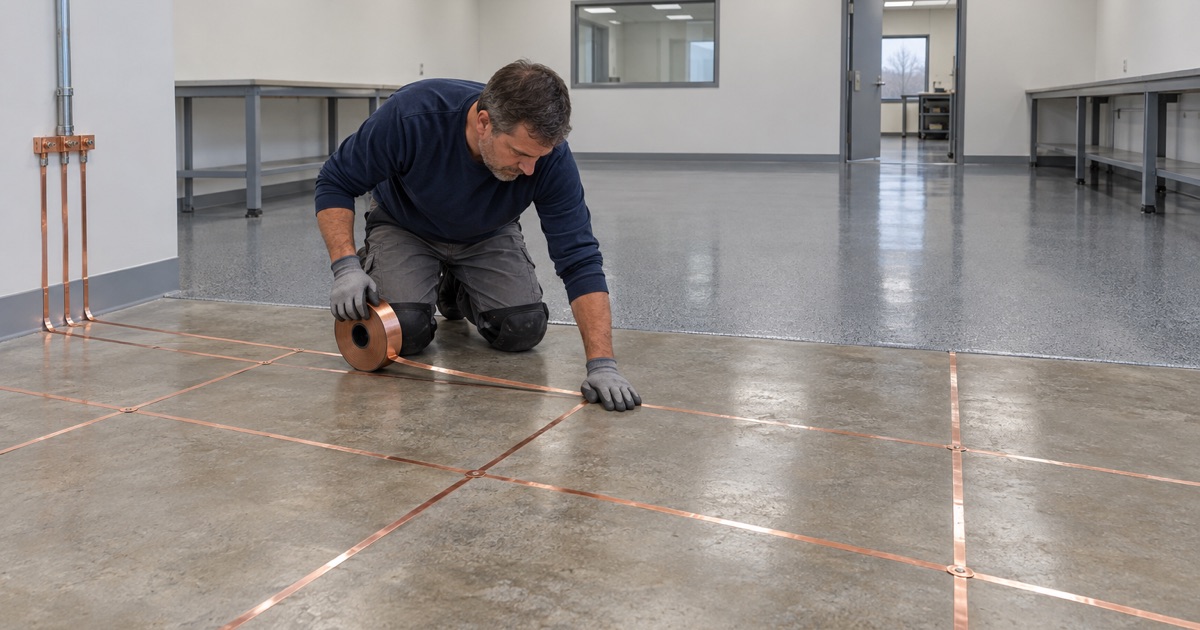
The system is connected to ground through copper strips or grounding points tied into the building’s grounding system. A conductive primer spreads that connection across the floor so the topcoat has a continuous path to ground. The layout of grounding points is planned with your electrical staff and drawn into the proposal.
This layer is invisible once the floor is finished, but it is what makes the system work. A beautiful topcoat over a poorly grounded primer will not pass testing.
Static-Dissipative or Conductive Topcoat
The topcoat contains conductive materials that carry charge from the surface down to the primer and grounding. Conductive and static-dissipative products are formulated for different resistance ranges, and we select the one that matches your requirement. Colors are usually limited compared with decorative floors, since the conductive additives affect appearance.
Testing, Documentation and Care
Resistance Testing
We measure resistance to ground and point-to-point resistance across the floor using a meter and standard electrodes, and we can include system tests with a person wearing ESD footwear. Readings are taken at points across every room, not just one corner, and recorded on a floor plan.
Those records give your ESD program a baseline. Later readings can be compared with it to show whether cleaning, wear or damage is changing performance.
Cleaning and Maintenance
Ordinary floor waxes and some cleaners leave an insulating film that defeats an ESD floor. We provide care instructions that call for cleaners approved for ESD surfaces and advise against finishes that are not. Regular cleaning also keeps dust from building up and affecting readings.
If an area is damaged, it can usually be repaired and recoated with the same system. We test the repaired area afterward to confirm it matches the rest of the floor.
Planning an ESD Floor Project
Working From Your Specification
Most ESD floors are built to a requirement set by someone other than the flooring contractor: a corporate ESD program, a customer’s quality standard or an equipment manufacturer. We ask for that document early and build the proposal around it, so the resistance range, test method and footwear assumptions are settled before any material is ordered.
If no written requirement exists yet, we explain the difference between conductive and dissipative systems and the questions your team should answer. The choice belongs to the people who run the program, and the floor should match their decision rather than our preference.
Schedule and Return to Service
An ESD floor takes several steps that each need to cure: primer, grounding, conductive layers and topcoat, followed by testing. We give you a schedule with every step and the date testing will be complete, so equipment can be moved back with confidence that the floor is ready.
- 20+ Years Coating Concrete
- Moisture Test in Every Scope
- Free Written Estimates