Iowa City Epoxy Flooring installs polyaspartic floor coating systems in Iowa City, IA, serving surrounding cities including Coralville, Tiffin, North Liberty, Mount Vernon and Amana. Polyaspartic is the fast-curing, color-stable coating that has changed how garage and commercial floors are installed, and we have spent more than twenty years learning where it shines and where an epoxy or urethane system is the better call.
A polyaspartic floor is still only as good as the concrete beneath it. We grind every slab with diamond tooling, test it for moisture before the price is final, repair cracks and spalls, and then build the system to the number of coats and finished thickness written in your proposal.
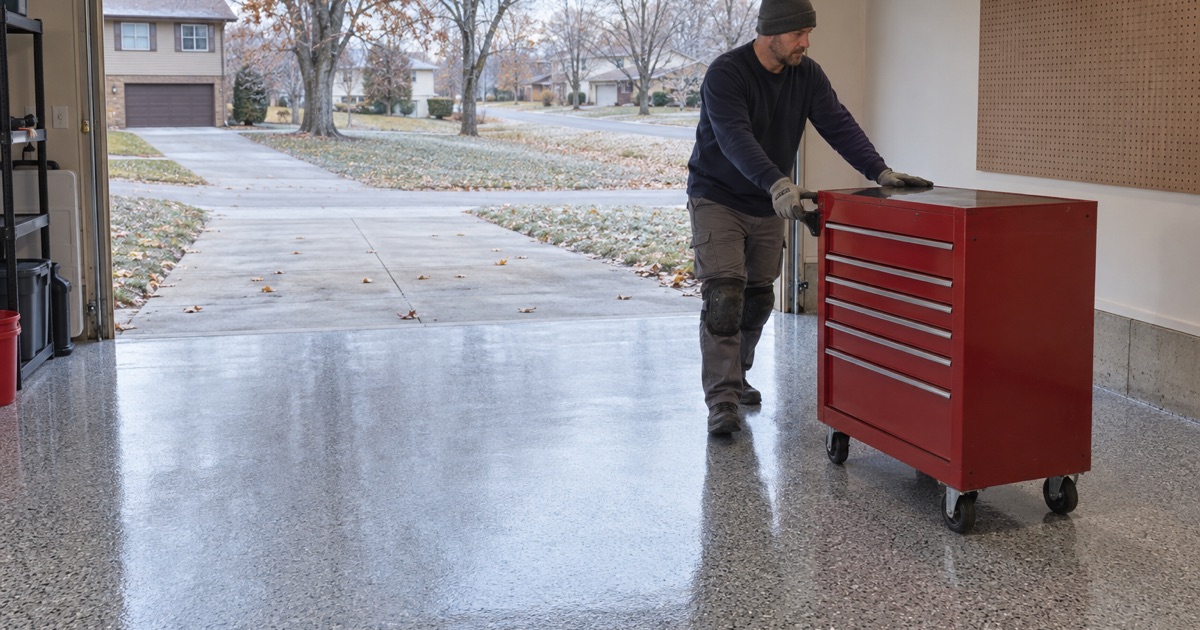
What polyaspartic changes is speed and durability at the surface. It cures in hours rather than days, holds its color when sunlight pours through a garage door, and resists the abrasion and hot tire pickup that wear out weaker coatings.
What Polyaspartic Is and Why It Matters
A Faster-Curing Coating Chemistry
Polyaspartic is a type of aliphatic polyurea. Like epoxy, it is a two-part coating that reacts to form a hard film, but it reacts much faster, which is why a coat can be ready for the next step in hours instead of overnight.
That speed is useful for homeowners who want the garage back quickly and for businesses that cannot close for long. It also means the installer has a short working time, so batch size, crew size and the order of work all have to be planned before the first can is opened.
Color Stability Under Sunlight
Ordinary epoxy can amber, or yellow, when it is exposed to ultraviolet light. Polyaspartic topcoats are made to resist that, so a gray floor stays gray and a flake blend keeps its colors near the open door.
For garages that face west or south, or showrooms with big windows, that difference is visible within a season or two. It is one of the main reasons we put a polyaspartic topcoat over an epoxy base in so many homes.
Abrasion, Chemical and Hot Tire Resistance
A cured polyaspartic topcoat is hard and tough, which helps it resist scratches from grit, dropped tools and bike stands. It also stands up to many automotive fluids, deicing brine and household cleaners.
Hot tire pickup, where a warm tire softens a coating and peels it away, is a common failure of thin garage paints. A properly bonded system with a polyaspartic wearing surface resists it far better.
Polyaspartic Systems We Install
Epoxy Base With Polyaspartic Topcoat
Our most common garage system uses a 100% solids epoxy base for bond and build, a vinyl flake broadcast, and a clear polyaspartic topcoat for wear and UV stability. It combines the strengths of each material and gives a thick, textured floor.
The epoxy base fills the profile left by grinding and gives the floor body. The polyaspartic top seals the flake in and takes the daily wear, and it can be renewed later without removing the whole system.
Full Polyaspartic Systems
Where speed matters most, the base, broadcast and topcoat can all be polyaspartic. This allows the fastest return to service, which suits businesses, rental turnovers and homeowners with tight schedules.
The tradeoff is that a full polyaspartic base is less forgiving on a slab with moisture or heavy repair work. We recommend it only after the slab test and survey show it is a good candidate.
Quartz and Grit-Textured Topcoats
For ramps, entries, commercial restrooms and areas that stay wet, we can broadcast quartz into the system or add grit to the polyaspartic topcoat. That builds traction into the coating itself rather than relying on mats.
The amount of texture is specified in the proposal by the broadcast and additive used. A floor that is too aggressive is hard to clean, so we match the texture to how the space is used.
Preparing the Slab for Polyaspartic
Diamond Grinding to a Real Profile
Polyaspartic needs an open, clean surface to bond to. We diamond grind the entire slab to an ICRI concrete surface profile suited to the system, and we never rely on an acid etch, which leaves an uneven surface and residue that weakens the bond.
Grinding also removes old paint, sealers and contamination. Dust is captured at the machine with a vacuum, keeping it out of the house and away from floor drains.
Moisture Testing Before the Price Is Set
Every slab is tested for moisture before we finalize the proposal. A fast-curing coating can be especially sensitive to moisture coming up through the concrete, and finding it after the floor is down means blisters and peeling.
If a slab tests high, a moisture-mitigation primer may be needed. We explain that, along with the warranty exclusions for moisture and hydrostatic pressure, before the job is sold.
Crack and Joint Repair
Cracks are filled with a fast-setting repair material compatible with the coating, and spalls at doors and drains are rebuilt. Control joints can be filled or honored depending on how much the slab moves and the look you want.
We point out cracks that are likely to move again. A coating can bridge a hairline, but it cannot stop a slab from moving, and we would rather say so up front.
Where Polyaspartic Fits Around Iowa City
Garages Through Salt Season
A polyaspartic topcoat is well suited to garages that see meltwater and road salt from November through March. Its hard, chemical-resistant surface keeps brine on top, where a squeegee or rinse can clear it.
Its tolerance for lower temperatures also helps in the shoulder seasons. We still check slab temperature and the dew point spread on the day, and in an unheated garage in deep winter we may recommend waiting.
Shops, Showrooms and Commercial Spaces
For auto shops, retail spaces and showrooms, polyaspartic combines a fast reopening with a durable, attractive finish. Work can often be phased overnight or over a weekend so the business keeps running.
For heavy chemical exposure, thermal shock or constant washdown, we may recommend urethane cement instead. Choosing the right system for the room matters more than choosing the newest material.
Cost, Care and Renewal of a Polyaspartic Floor
What Drives the Price
Polyaspartic material costs more per gallon than most epoxies, so a full polyaspartic system usually prices above an epoxy-base system of the same size. Slab repair, old coating removal, a moisture-mitigation primer and the amount of flake or quartz broadcast all move the number as well.
The proposal breaks those out line by line, and it names the product line, the coats and the finished thickness. That lets you compare a polyaspartic quote with an epoxy quote on what you actually receive, not just the label on the can.
Everyday Care
A polyaspartic floor needs little more than sweeping or dust mopping and an occasional wash with a mild cleaner. Spilled oil, coolant and brine wipe up from the sealed surface, and a squeegee clears meltwater in winter.
Avoid strong acids and harsh solvent cleaners unless the product data sheet allows them. Pads under jack stands and furniture feet prevent the gouges that even a hard topcoat can take from a sharp point load.
Recoating a Worn Topcoat
After years of traffic, the topcoat in driving lanes or doorways can lose some gloss. Because the wearing layer is a separate coat, it can often be lightly abraded and recoated without grinding off the whole floor.
That renewal is far less work than a full replacement. It is one of the practical advantages of building the floor as a base, a broadcast and a topcoat rather than as one thin layer of paint.
When We Recommend Something Else
Polyaspartic is not the answer for every floor. A slab with high moisture readings may be safer under an epoxy system with a mitigation primer, a commercial kitchen may need urethane cement, and a quiet storage room may be well served by a simple solid-color epoxy.
We explain the reasons for each recommendation in plain terms. The goal is a floor that holds up in your space, not a sale of the most expensive product on the truck.
- 20+ Years Coating Concrete
- Moisture Test in Every Scope
- Free Written Estimates