
Iowa City Epoxy Flooring installs epoxy garage floor systems in Iowa City, IA, serving surrounding cities including Coralville, Tiffin, North Liberty, Mount Vernon and Amana. After more than twenty years on garage slabs in this part of Iowa, we build every floor the same way: grind the concrete open, test it for moisture, repair what the slab needs, and then lay down a system thick enough to stand up to hot tires and a winter of road salt.
A garage floor in Johnson County lives a harder life than most interior floors. It sees meltwater, brine, oil drips, dropped tools and temperature swings from a summer afternoon to a January night, often all in one year. A thin coat of paint over an etched slab rarely survives that, which is why our quotes describe a full-build system rather than a single color coat.
Every proposal we write names the product line, how many coats go down and the finished thickness. You can read that against the floor once it is done, and you can compare our quote with anyone else’s on equal terms.
Our Step-by-Step Epoxy Garage Floor Process
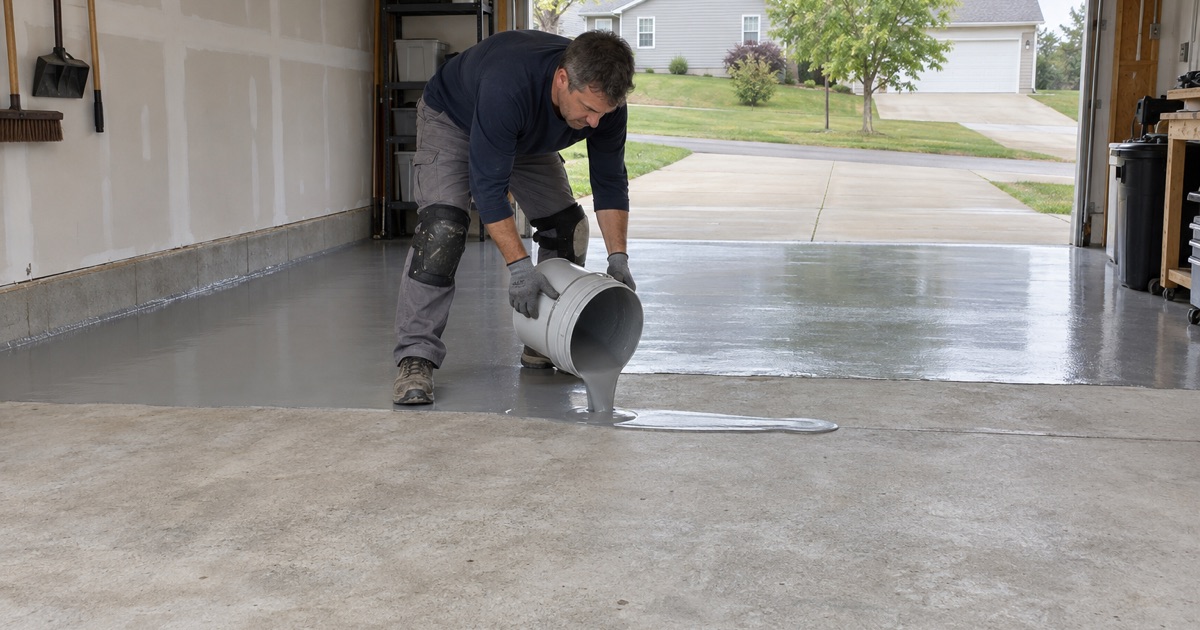
Step 1: Slab Survey and Moisture Test
We start by walking the slab with you, mapping cracks, spalls, pitting, oil stains and any old coating. Then we test for moisture, using a taped plastic sheet as a first read and calcium chloride or relative humidity testing where a number is needed. That result goes into the written scope before the price is set.
Step 2: Diamond Grinding and Dust Capture
The whole floor is ground with a diamond grinder to an open, textured profile, with edges and corners finished by hand tools. Our grinders run attached to a vacuum, so the dust is captured at the machine rather than drifting into the house or being washed toward a floor drain.
Step 3: Crack, Spall and Joint Repair
Cracks are chased and filled, spalled edges at the door and around the drain are rebuilt, and pitting is patched. Repairs are ground flush with the surrounding concrete so they disappear under the finished coating instead of showing through as ridges.
Step 4: Base Coat and Broadcast
A penetrating base coat of epoxy goes down over the prepared slab, and while it is still wet we broadcast vinyl flake or quartz to the coverage you chose. A full broadcast gives the most texture and hides the most, while a partial broadcast shows more of the base color.
Step 5: Scrape and Topcoat
Once the base cures, loose flake is scraped and vacuumed off and a clear topcoat seals the surface. For most garages that topcoat is a polyaspartic or polyurea, chosen for abrasion resistance, chemical resistance and color stability when the overhead door is open to the afternoon sun.
Garage Slab Conditions We See Around Iowa City
Salt Scaling and Pitted Driving Lanes
The wheel tracks of an uncoated garage floor often tell the story of past winters: pitted, scaled patches where brine soaked in and froze. We grind those areas back to sound concrete and fill the low spots before coating, so the new floor sits flat and does not hold puddles of meltwater.
Newer Slabs That Still Move Moisture
Garage floors are often poured without the vapor retarder that sits under heated rooms, which the residential code allows. That means a garage built in the last decade can push more moisture than an older one, and it is why we test every slab regardless of the age of the house.
Old Paint, Sealers and Failed Coatings
Many garages we see already carry a roll-on paint or a big-box kit that has started to peel at the tire tracks. Those layers have to come off completely; a new coating is only as strong as whatever it is stuck to.
Choosing a Garage Floor System
Flake Floors for Everyday Garages
A full vinyl flake broadcast is the most common garage choice because it hides dust, tire marks and small slab flaws. It also adds a texture that helps underfoot when snow melts off a car, and chip size and blend let the floor match the house or the workshop inside it.
Metallic and Solid Color Garage Finishes
Some owners want a showroom look, and a metallic epoxy gives a marbled, reflective finish that suits a collector garage. A solid color coating is a simpler, lower-cost option for a working garage, and we can add grit to the topcoat for traction.
Polyaspartic Topcoats and Faster Return to Service
Polyaspartic topcoats cure faster than epoxy and resist yellowing in sunlight, which makes them a strong fit for garages with west-facing doors. They also resist hot tire pickup and many automotive fluids, and their quick cure can shorten the time the garage is out of use.
That speed has a cost on the installer’s side, because a fast-curing material leaves less working time on a large floor. We plan crew size and batch sizes around it, so the topcoat goes down evenly instead of showing lap marks where one batch met the next.
What Moves the Price of an Epoxy Garage Floor
Size, Layout and Slab Repair
Square footage sets the baseline, but layout matters too: a garage with a step-down, a floor drain, a stem wall or a lot of edge work takes more hand grinding than an open rectangle. The amount of crack, spall and pitting repair is usually the biggest variable after size, and it is the part a phone quote cannot see.
We price repair from the slab survey rather than from a flat allowance. If the driving lanes are deeply scaled or the apron edge has broken away, that work shows up as its own line so you can see exactly what it adds.
Moisture Results and Primer
A slab that tests dry takes the standard base coat. A slab that tests high may need a moisture-mitigation primer first, which adds material and a day to the schedule but keeps vapor from lifting the floor from below.
Because the test happens before the price is final, that decision is made on paper with you, not discovered halfway through the job. It is also tied to the warranty, since moisture from beneath the slab is the first thing most coating warranties exclude.
System Choice and Finished Thickness
A solid color with a single topcoat costs less than a full flake broadcast with a polyaspartic top, and a metallic floor costs more than both because of the extra labor in placing it. More coats and a thicker build cost more up front and wear longer at the tire tracks and under the workbench.
That is why the proposal names the coats and the finished thickness. Two quotes for an epoxy garage floor can describe very different floors, and those two numbers are the quickest way to tell them apart.
Living With a Coated Garage Floor
Winter Care in Salt Season
From November through March, the main job is keeping salty meltwater from sitting on the floor for weeks. A squeegee toward the door or the drain after a heavy storm, and a rinse with clean water now and then, keeps the topcoat from dulling under dried brine.
A rubber mat under each car can help in a garage where snow packs into the wheel wells. Avoid mats with a latex backing, which can stain some coatings, and lift them now and then so water does not stay trapped underneath.
Everyday Cleaning and Spills
A soft broom or dust mop and a mild cleaner handle most of what a garage floor sees. Oil, antifreeze and brake fluid wipe up easily from a sealed surface, though it is still best to clean them promptly rather than letting them sit.
Skip harsh acids and citrus degreasers unless the product sheet allows them. Dragging steel stands, sharp jacks or furniture without pads can scratch even a hard topcoat, so a piece of plywood under a jack stand is cheap protection.
- 20+ Years Coating Concrete
- Moisture Test in Every Scope
- Free Written Estimates