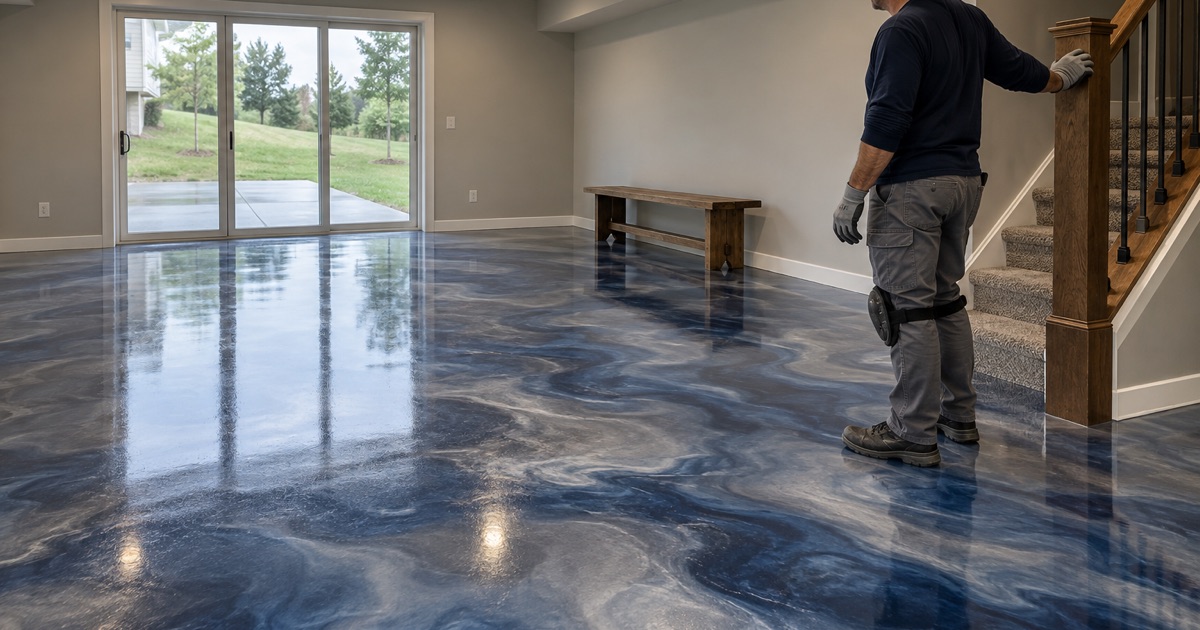
Iowa City Epoxy Flooring installs metallic epoxy floors in Iowa City, IA, serving surrounding cities including Coralville, Tiffin, North Liberty, Mount Vernon and Amana. A metallic floor uses pearlescent pigments suspended in a clear epoxy, and as the coating levels the pigment moves into swirls, ripples and depth that look more like polished stone or liquid metal than a painted floor.
It is the most artistic system we install, and it is also the least forgiving. The slab has to be ground flatter than for a flake floor, the moisture question has to be answered first, and the metallic coat has to be placed by an installer who knows how the material moves during its short working time.
With more than twenty years of floor work behind us, we treat a metallic floor as both a coating job and a design job. You see samples, agree on colors and movement, and get a written proposal that names the product line, the coats and the finished thickness before any pigment is mixed.
How a Metallic Epoxy Floor Is Built
Slab Grinding and Flatness
Every metallic floor starts with diamond grinding to open the concrete and remove old coatings, sealers and contamination. Because the finished floor is reflective, we also grind down ridges and high spots more carefully than we would under a flake broadcast.
Low spots, trowel marks and patch edges are filled and ground flush. Any dip that holds a shadow on bare concrete will show as a dark ripple in a mirror-like finish, so this step decides how good the floor can look.
Primer and Base Color
After grinding and repair, a primer seals the concrete and a tinted base coat sets the background color. The base matters more than most people expect, since a dark base deepens a metallic and a light one makes it brighter and softer.
If the moisture test shows high readings, the primer is a moisture-mitigation product. That protects the floor from vapor lifting it from below, which is especially important for a system this visible.
The Metallic Coat
The metallic layer is mixed with the chosen pigments and poured in a thicker coat than a standard epoxy. While it is still wet, we work it with rollers, brushes, sprayers or solvent misting to shape the movement, from soft clouds to strong veining.
The working time is short and the slab temperature affects it. We read the slab and the dew point on the day and adjust crew size and batch size so the whole floor is placed while it is still workable.
Clear Topcoat
A clear topcoat protects the metallic layer from abrasion, chemicals and sunlight. For most floors we use a polyaspartic or urethane top, both of which resist yellowing far better than epoxy alone.
The topcoat also sets the sheen. A high gloss shows the most depth, while a satin finish hides dust and fine scratches better in busy rooms.
Choosing Colors and Movement
Single-Color Metallics
A single metallic color over a matching base gives a calm, elegant floor with soft depth. It suits offices, living spaces and showrooms where the floor should support the room rather than dominate it.
Single-color floors are also the easiest to keep consistent across large areas. That makes them a good choice for open commercial spaces where the floor has to read as one surface.
Blended and Veined Designs
Two or three colors worked together can create marbled veining, ocean-like ripples or a stone effect. These designs take more time to place, and they show the hand of the installer more than any other floor.
We show you samples of how blends behave and talk through the level of movement you want. Strong veining in a small room can feel busy, while the same look in a large space can be striking.
Matching the Room and Light
Metallic floors change with light. Daylight through a garage door, warm interior lighting and showroom spotlights all bring out different tones in the same pigment.
Where possible, we look at samples in the actual room. Seeing the color under your lights is the best way to avoid surprises when the floor is finished.
Where Metallic Epoxy Works Best
Showrooms, Offices and Retail
In showrooms, salons, offices and shops, a metallic floor gives a finished, custom look without the joints of tile. It reflects light well, which can brighten a space and draw attention to what is displayed on it.
For commercial spaces we plan the work around business hours and can install in phases. Traffic lanes and entries get a harder topcoat, and walk-off mats help keep grit off the finish.
Basements and Living Spaces
In finished basements, a metallic floor can look like a designed interior instead of a utility slab. The moisture question still comes first, and we check the sump pit, floor drains and the slab itself before recommending a metallic system below grade.
We also use low-odor products in occupied homes as a comfort choice. That keeps the work more pleasant for anyone living upstairs during the installation.
Collector and Show Garages
Some garage owners want a floor that matches the cars parked on it. A metallic floor with a UV-stable topcoat and a grit additive can work in a garage, though it shows dust, salt residue and tire marks more than a flake floor.
We are honest about that tradeoff. In a daily-driver garage through an Iowa winter, a flake floor is usually more practical; in a heated show garage, a metallic floor can be a centerpiece.
What Shapes the Cost of a Metallic Floor
Surface Preparation and Flatness Work
Because a reflective floor shows every dip, a metallic job usually needs more grinding, patching and skim work than a flake floor of the same size. A slab with old adhesive, heavy patching or uneven trowel work takes longer to bring to the standard a metallic finish needs.
We price that preparation from the slab survey, not from a flat allowance. The proposal shows it as its own line, so you can see how much of the cost is in the concrete and how much is in the finish.
Material and Number of Colors
Metallic coats go down thicker than ordinary epoxy, and the pigments themselves add cost. A two- or three-color blend takes more material and more placement time than a single color, and a large floor may need several installers working at once.
The written proposal names the product line, the coats and the finished thickness. Those details let you compare a metallic quote fairly with any other, because two quotes using the same name can describe very different floors.
Topcoat, Texture and Moisture Primer
A polyaspartic or urethane topcoat costs more than a plain epoxy top but holds its clarity under sunlight and traffic. Adding a grit for traction, or a moisture-mitigation primer where the slab tests high, also changes the total.
We explain why each item is or is not recommended for your room. A basement family room, a heated show garage and a retail floor each need a slightly different build, and the price follows the build.
Caring for a Metallic Floor
Routine Cleaning
Dust mop often and clean with a pH-neutral cleaner and a soft mop. Grit is the main enemy of a glossy floor, so walk-off mats at doors make a real difference.
Avoid harsh degreasers, acids and abrasive pads, which can dull the topcoat. For spills like oil or coffee, a prompt wipe is usually all the floor needs.
Protecting the Finish
Use felt pads under furniture and avoid dragging heavy objects across the floor. If the topcoat wears in traffic lanes over the years, it can usually be lightly abraded and recoated to restore the sheen without disturbing the metallic layer underneath.
That renewal is one reason we build the floor in separate layers. The metallic coat carries the look, and the clear top carries the wear, so the part that ages is the part that can be refreshed in a day.
- 20+ Years Coating Concrete
- Moisture Test in Every Scope
- Free Written Estimates